Private Label Perfume for the EU: A Buyer's Checklist Before Tooling
Private label perfume lets a brand sell a scent it did not formulate, but it does not move the product's legal obligations to the factory. In the EU the brand named on the pack is the responsible person, so the safety assessment, the product information file and the notification stay on the buyer's side of the table even when the factory supplies the data. Settle four things before tooling opens: who holds the formula, who holds the safety dossier, what the label says, and what the first production run has to prove.
Key takeaways
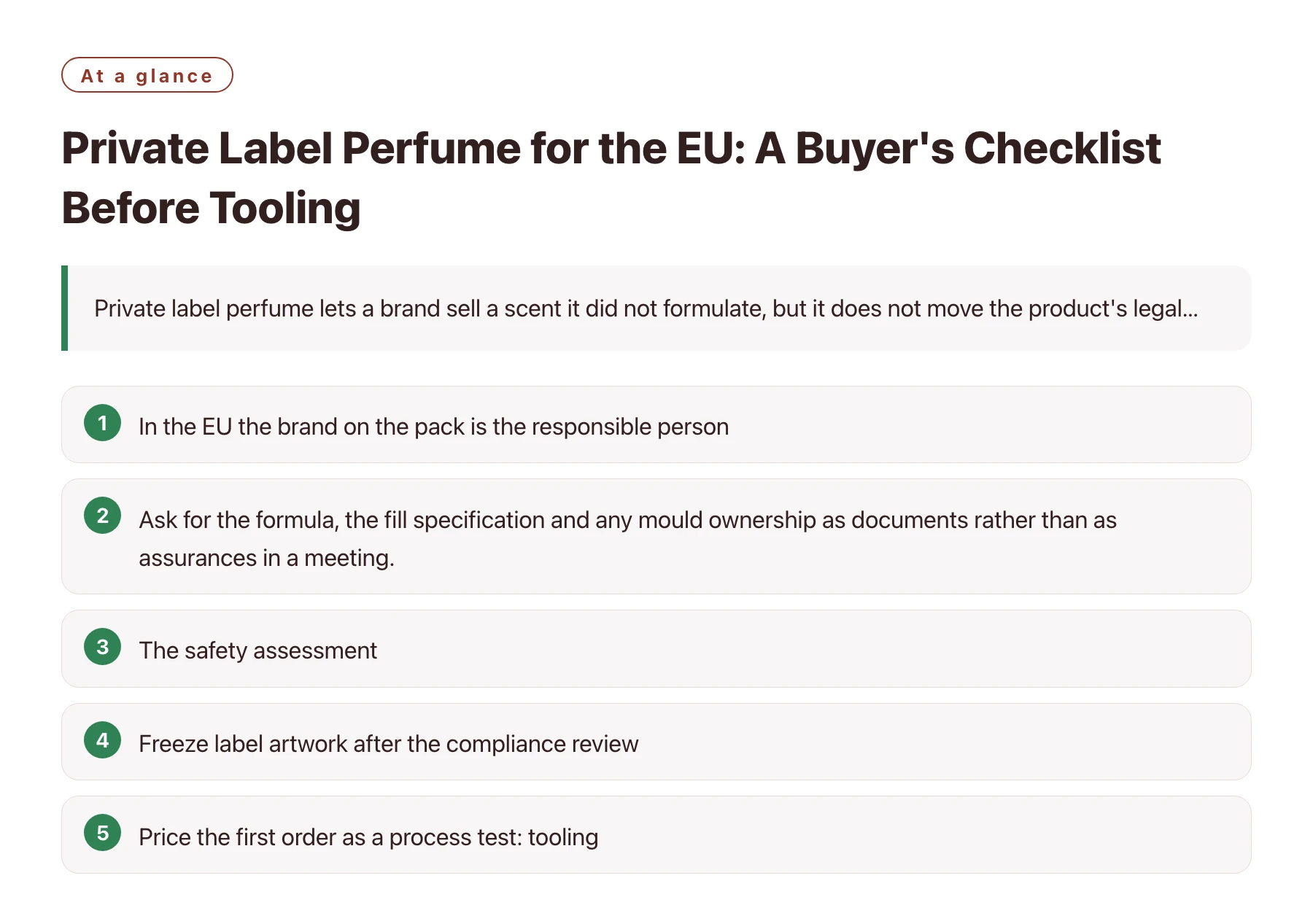
- In the EU the brand on the pack is the responsible person, so private label transfers the manufacturing work but not the legal accountability.
- Ask for the formula, the fill specification and any mould ownership as documents rather than as assurances in a meeting.
- The safety assessment, the product information file and the market notification sit with the brand, which is why they belong in the launch budget [1].
- Freeze label artwork after the compliance review, not before, because an ingredient list or claim change can invalidate a print run.
- Price the first order as a process test: tooling, fill, decoration and paperwork rarely fail on the second run if they were checked on the first.
Most private label conversations start with a scent direction and a unit price. Both matter, but neither is the decision that determines whether a launch lands on time. The decision that does is the division of responsibility between the brand and the factory, and it is usually left implicit until something goes wrong.
That gap is widest in Europe, where cosmetic products are regulated as products rather than as manufacturing arrangements. A factory can develop the juice, fill the bottle and print the carton, and the brand can still be the party that has to answer for the label, the claims and the dossier.
This is written for a brand owner preparing a first EU launch, or a second one after a supplier change. It is a checklist, not a legal opinion; the point is to know which questions to ask and in what order.
What private label hands over, and what it does not
Private label usually means the manufacturer or a partner perfumer develops the scent from a brief, and the brand puts its own name on the finished product. That is the practical difference from a fully custom project, where the brand arrives with a brief detailed enough to define the juice. What stays with the brand in both cases is the product definition: what the scent is for, what it must not contain, how it will be described, and where it will be sold.
A factory can hold the technical data for a base. The product on the shelf is still the brand's product. For an EU launch that distinction matters, because the obligations attach to the product, not to the manufacturing relationship. Buyers who assume private label is a turnkey legal service tend to find the gap during the label review, which is the most expensive possible moment to find it [1].
The formula, the specification and the mould
Ask for the formula, the specification sheet and the fill specification as documents. If the project uses a custom bottle mould or a bespoke cap, settle ownership of the tool in the same conversation. A partner that treats Xuelei private label perfume manufacturing as a defined service will normally have these papers ready; one that does not may be selling a stock product with a new label.
The formula also has to be readable against the industry's own restrictions. The IFRA Standards set use limits for a long list of materials, and a supplier working to them can show how a specific formula was checked rather than asserting that it is fine [3].
There is a simple test. If the relationship ended next quarter, could another factory reproduce the product exactly? If not, the missing pieces are commercial terms that have not been negotiated yet.
The retained reference sample
Keep a sealed, labelled reference sample from the approved batch, signed by both parties and stored on both sides. Bulk approval, repeat orders and any later dispute are all measured against that sample. A photograph is not a reference, and neither is a shared memory of a meeting.
The EU items to settle before tooling opens
| Item | What it covers | Where it normally sits |
|---|---|---|
| Safety assessment | A cosmetic product safety report signed by a qualified assessor, built on the formula and the raw material data | Brand side, working from factory data |
| Product information file | The dossier kept available to the authority: formula, method of manufacture, safety data, labelling | Brand side |
| Market notification | Informing the market where the product is placed before it is offered for sale | Brand side |
| Labelling | Ingredient list in the required order, warnings, nominal content, batch code, responsible person | Brand side, artwork often made by the factory |
| Primary packaging | Material choice and the packaging information expectations that follow from it [2] | Shared decision, factory input |
Read the third column as the real deliverable of this table. The factory supplies information and the brand signs the declaration, so the compliance work has to be funded and staffed on the brand side rather than assumed to be part of the manufacturing fee.
A sequence that keeps the launch date honest
- Brief and screening. One page covering scent family, price target, pack format and destination market. Send the identical page to three suppliers and compare the answers line by line instead of comparing headline prices.
- Sample round and revision. Expect at least one revision. Judge the revision against the specific notes you wrote, not against your overall impression of the first sample.
- Compliance review before artwork. Have the formula and the draft claims reviewed before the label is finalised. Artwork changes are cheap; reprinted cartons are not.
- Pilot run and release. Approve against the retained reference sample and against the fill weight tolerance written into the specification, and ask for the batch record.
- Repeat order. Treat the second order as the real test of process. A supplier that cannot repeat the first order is a sample house, not a production partner.
How to compare private label quotations
A private label quote that omits tooling, decoration or documentation is not cheaper; it is incomplete. Normalise every offer to the same scope first, then compare the total cost to the first sellable unit rather than the cost per bottle. Asking each supplier to price the same written scope is what makes the comparison meaningful, and a partner such as a contract manufacturer for perfume brands that publishes its scope makes the normalisation straightforward, because the scope is already on the page.
It also helps to know what a well-run private label line looks like from the outside. what a good private label perfume factory looks like is worth reading before the first call, because the questions it raises are the ones that separate a supplier with a documented process from one that is improvising.
Where first-time buyers lose money
The three recurring losses are an unfrozen formula, an unfrozen label and an undefined reference sample. Each one is cheap to fix in week one and expensive to fix in month six, because by then tooling, print and freight are already committed.
Certification lists are a reasonable starting point for screening, and a supplier that publishes its background and certifications is easier to check than one that does not. But a certificate shows that a management system was audited; it does not show what happened on your batch. Ask for one batch record from intake to release and walk through it.
Put the model, the ownership of the formula and the mould, the reference sample and the documentation list on a single page, and have both sides sign it. Everything else in the project will move. Those four points should not.
Sources
- European Commission: Cosmetics in the EU —— The European Commission's overview of EU cosmetics rules, including the responsible person, product information file and safety report requirements.
- European Commission: Packaging Waste and the PPWR —— EU rules on packaging and packaging waste, including the Packaging and Packaging Waste Regulation requirements on recyclability and design.
- IFRA Standards Library (International Fragrance Association) —— The IFRA Standards Library lists the restrictions the fragrance industry applies to individual fragrance ingredients, based on safety assessments; it is the reference point for compliant fragrance formulation.
Frequently asked questions
Does private label mean the factory handles EU compliance for me?
No. The factory can supply the formula data, the safety information and the manufacturing method, and it can print the artwork. The responsible person on the label, the safety report, the product information file and the market notification remain the brand's obligations.
Can I start with a stock base and make it exclusive later?
Sometimes, but the timing matters. Exclusivity is a commercial term, and once a base is in use for other clients the supplier has little reason to withdraw it. Negotiate the exclusivity clause before the first sample is approved, not after the launch.
How many sample rounds should a private label project budget for?
Two to three is normal for a scent developed from a brief. One round is possible when the brief is unusually precise. Budget the cost and the weeks for at least two, and treat a third as a schedule risk rather than a sign of a bad supplier.
What has to be in the specification sheet?
At minimum the reference formula code, the concentration, the fill weight and tolerance, the pack components with their references, the batch coding method and the release criteria. If those are not written down, the first repeat order becomes a negotiation.
Is it cheaper to buy the bottles locally and fill in the EU?
It can be, and it can also add a second supplier to manage, a second quality standard and a second freight leg. Run the comparison on landed cost and on lead time together. The cheaper option on paper is often the slower one in practice.
What should trigger a supplier change?
Two consecutive failures on the same checkpoint: a fill weight outside tolerance, a decoration that misses the approved artwork, or a late document pack. One failure is an incident. A repeat of the same failure is a process problem.